
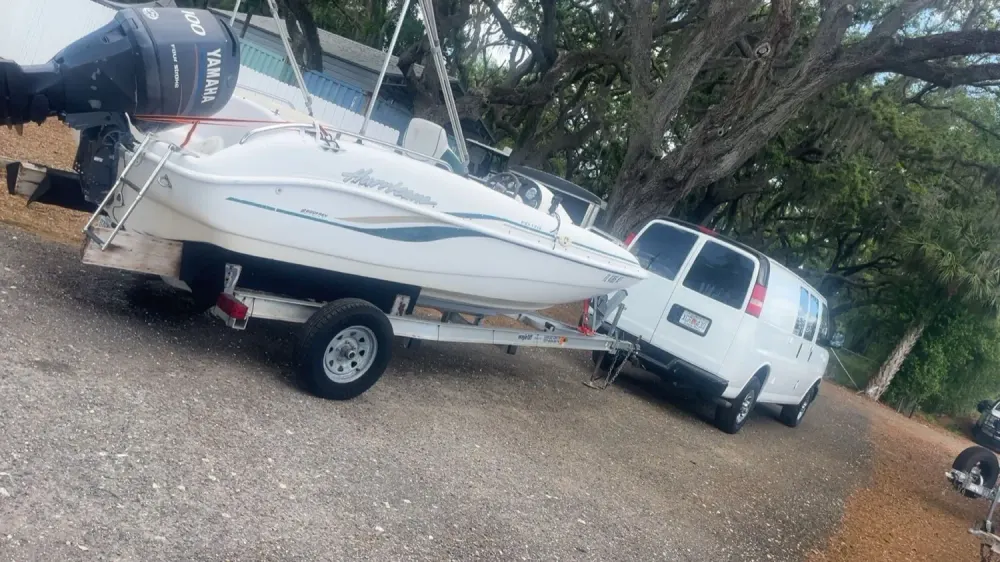
What we check before we roll
The tow is only as good as the trailer under the boat
Here is the honest shape of this: we tow, we do not own a boat trailer. So the boat has to be sitting on its own. If it is, the job is straightforward, and a deck boat with an outboard on an aluminum trailer is exactly the kind of load our van pulls. If the boat is in the water, or the trailer belongs to somebody else, or there is no trailer at all, that is a different service and a different call. Nobody is better off if you find that out when the van pulls up.
What actually gets checked before anything moves is the trailer, because the trailer is the whole job. Coupler seated on the ball and actually latched, with the pin in, not just dropped on and trusted. Tongue weight sitting right, so it is nose-down enough to stay planted instead of sway-happy at 50 on the Courtney Campbell. Safety chains crossed underneath the coupler in an X, which is the part everybody skips, and the reason is simple: if the coupler ever came off the ball the crossed chains cradle the tongue instead of letting it dig into the pavement. Lights plugged in and working, brake and turn both, because a boat trailer blocks every light on the van. Tires and bearings get a look. A boat on a sound trailer is a straightforward tow. A boat on a trailer with bald tires or bearings that have been sitting in salt for three years is not a tow, it is a roadside breakdown with a boat attached, and we will tell you that before we hook up rather than on the shoulder of US 19.
- Cargo van with a real tow hitch and ball mount, sized for a deck boat on an aluminum trailer
- Coupler seated, latched, and pinned to the ball before anything moves, every time
- Safety chains crossed in an X under the coupler so the tongue is cradled if it ever comes off the ball
- Trailer lights plugged in and confirmed working, brake and turn, before we pull out
- Tongue weight, tires, and bearings checked, and we say something if the trailer is not fit to roll